The Hypothermia Paradox: Why Rewarming the Wrong Way Kills
You found a freezing hiker. You rubbed their arms, gave them warm tea, and stood them up by the fire. Five minutes later, their heart stopped. Discover the lethal science of "Core Temperature Afterdrop."
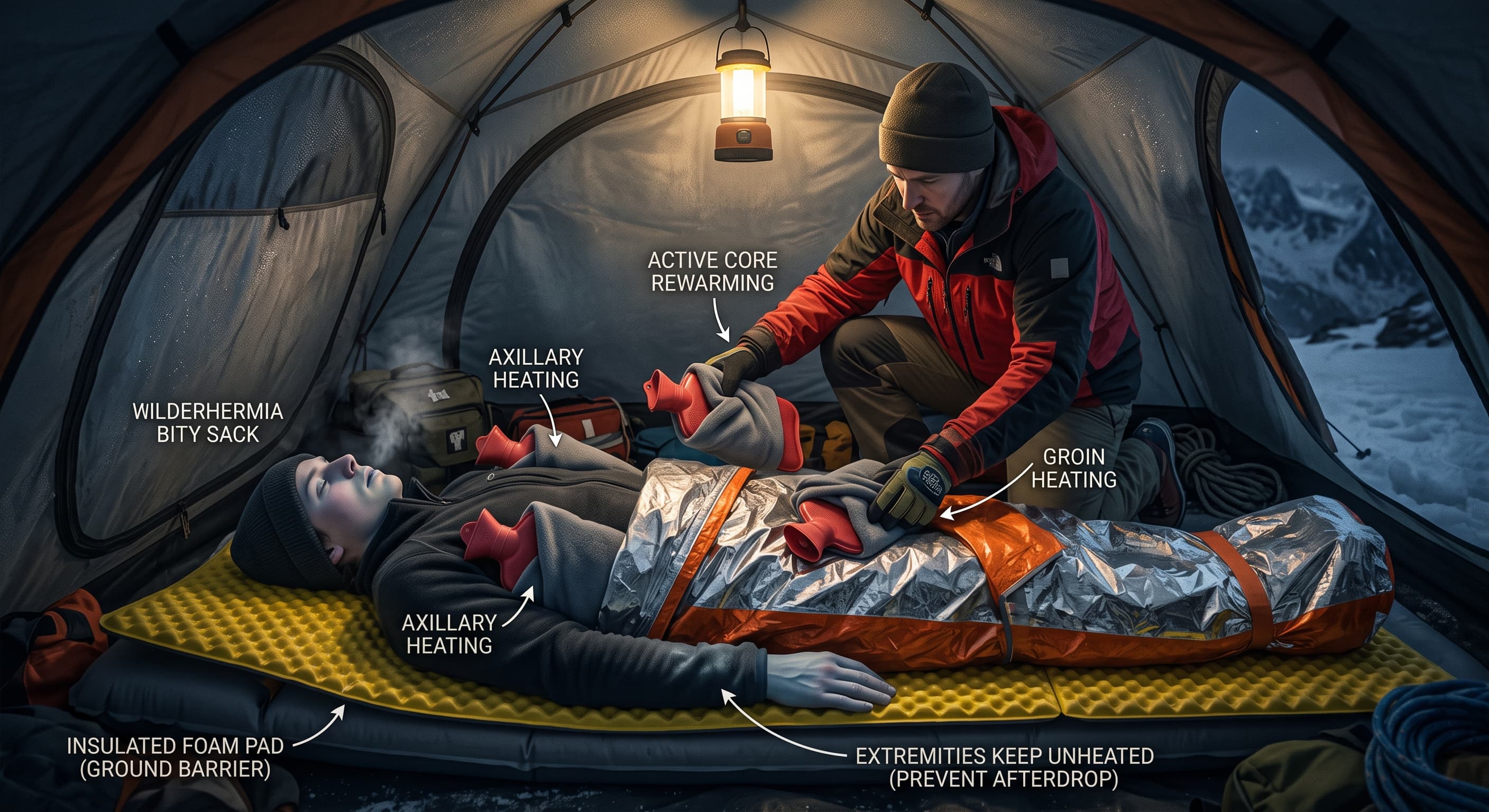
Imagine this scenario: Your team locates a missing hiker who has been exposed to freezing rain for 12 hours. They are pale, shivering violently, and slurring their words. Instinctively, your team springs into action. You pull them up to their feet to walk them toward the campfire. You vigorously rub their icy arms and legs to "get the blood flowing."
Suddenly, the hiker collapses. You check for a pulse. There is none. In your desperate attempt to save their life, you just triggered a fatal cardiac arrest.
The Science of "Core Temperature Afterdrop"
To understand this paradox, you must look at how the autonomic nervous system defends the body. When core temperature drops, the brain initiates massive peripheral vasoconstriction. It clamps down the blood vessels in the arms and legs, sacrificing the extremities to keep the warm blood entirely around the heart, lungs, and brain.
The blood trapped in the freezing arms and legs becomes stagnant, severely acidic, and icy cold.
"If you apply heat to a hypothermic patient's extremities, or force them to walk, you instantly reverse that life-saving vasoconstriction. The vessels dilate, and a tidal wave of cold, highly acidic blood rushes back to the heart. This drops the core temperature instantly—a phenomenon called 'Afterdrop'—and throws the irritable heart into terminal Ventricular Fibrillation." – Dr. Mouine Khalil Errahmane Ameur, Off-Grid Medical Care
The Survival Protocol: How to Rewarm Safely
In wilderness medicine, a moderately to severely hypothermic patient (someone who has an altered mental status or has stopped shivering) is as fragile as a pane of glass. You must handle them like a ticking bomb.
- Keep Them Horizontal: Never allow a severely hypothermic patient to sit, stand, or walk. Keep them perfectly flat. Gravity combined with an upright posture will pool blood in the legs, starving the brain and straining the heart.
- Gentle Handling: Do not rub their limbs. Do not drag them roughly. The hypothermic heart is incredibly irritable; a sudden jolt or rough handling is enough to trigger a lethal arrhythmia.
- Warm the Core ONLY: If using active external rewarming (like hot water bottles or chemical heat packs), apply them exclusively to areas of high central vascularity: the armpits (axillae), the groin (femoral arteries), and the upper chest.
- Insulate, Don't Bake: Your primary goal is to stop further heat loss. Strip wet clothing immediately by cutting it off, and package the patient in a multi-layered vapor-barrier system (the "Burrito Wrap").
The "Cold Heart" Exception
If the patient appears dead, remember the wilderness axiom: "Nobody is dead until they are warm and dead." Cold protects the brain from hypoxia. However, a profoundly cold heart beats very slowly—perhaps only 10 beats per minute. You must assess the carotid pulse for a full 60 seconds. If you start CPR on a heart that is actually beating, your chest compressions will kill them.
Survival in extreme environments requires overriding human instinct with clinical science. Learn how to construct the perfect "Hypothermia Burrito Wrap," execute the "Thaw Decision" for frostbite, and manage the Lethal Triad of trauma in the definitive 410-page manual: Off-Grid Medical Care. [Link to Book]